One character. Four tempos. A pantry that can run out.
Fabled Chronicles is a turn-based battle world with a card table, a farm that keeps a season, and a stake for someone who would rather hold than swing. Crypto is a door. The game is the house.
Steam
Browser
App Store
Google Play
Solana Seeker
Overview
The same account, wherever the screen is.
Cross-play means the fight you left on a desktop can be the fight you open on a phone. Gold, levels, the farm, the bag, and the guild follow the account. On a phone the adventure always opens. The wallet opens where that store allows it.
The spine is a turn-based MMORPG. Around it, the game holds a small economy so a week has more than one verb. Land runs out. Crops take a season and can rot. A tonic is a drink that had to be grown. A prize pays from a bucket that had to be filled.
ActiveThe battle
Rounds, four classes, a forge, companions, and a guild. You press the buttons.
Idle, with a planCardz
Three arena plots. A fresh Common starts at 8 damage. A fresh Fabled starts at 28.
Semi-passiveThe acre
Seasons and market prices. The harvest becomes a tonic, and the shelf can sell out.
PassiveThe stake
Relics and class desks. A quiet month is a thin dividend. An empty desk pays zero.
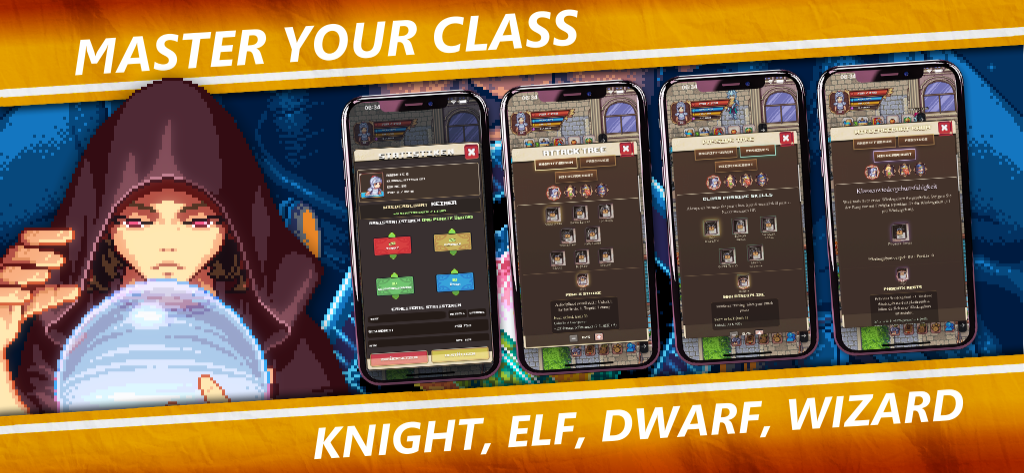
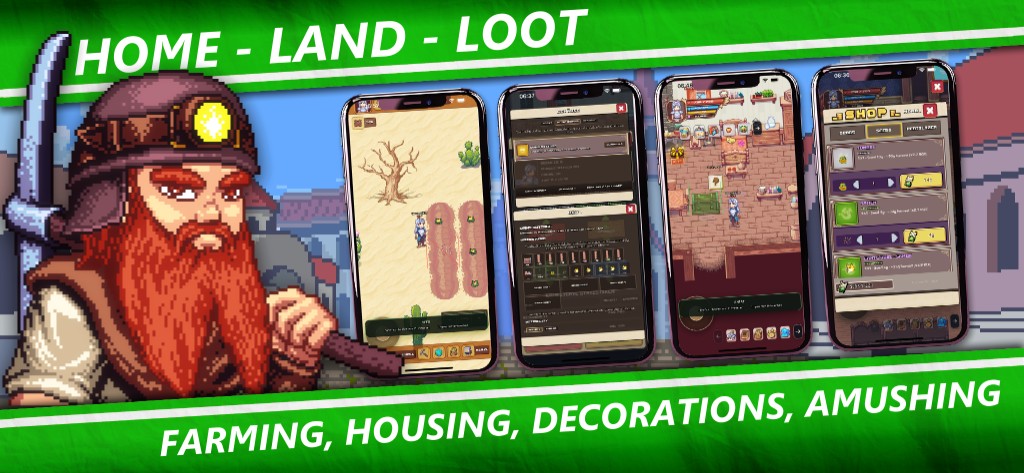
Turn-based varietySolo, PvP, party, the tower, and endless battles.Open worldTowns, auctions, and homes.Master your classKnight, elf, dwarf, and wizard.AdventureStory quests, daily quests, lore acts, and the quest guide.Home, land, lootFarming, housing, and decorations.Loot, luck, ratingsLeaderboards, the wheel, chests, and card packs.Mini-games and fortuneIdle battle, rummy, mau mau, flower poker, memory, and fishing.
The end
Free to play is the door. A person can fight, farm, and come back tomorrow with no wallet and no purchase. With nothing staked, the Memory claim stops at 100 for the day. The dungeon opens whether or not a purse was filled that week.
Play to earn is the purse. It pays a share of money that already arrived: in-app purchases, royalties, DEX fees, ecosystem funding, optional ads, auction-house fees, and claim fees. The studio is paid from the development weight, so the servers are a line in the same recipe as the prize. A thin week pays a thin prize. An empty week pays zero, and Tuesday still loads.
The cash taps are one recipe. Of $100 from purchases, royalties, DEX fees, or ecosystem funding, $9.26 deepens the liquidity pool, $30.54 keeps the game running, $16.67 fills that week’s leaderboard, $16.67 fills that week’s community distribution, $10.19 is charity, and $16.67 buys stock for the desks. Ads, if someone turns them on, pay that person $33 of every $100 first. The other $67 uses the same recipe. Auction fees, taken in $LORE, burn 67% and split the rest in half between the weekly board and the weekly community. A staking claim costs 3%. A daily-cap claim costs 2.8%. Half of either fee is burned, 17% funds the treasury, and 16.5% goes to each weekly purse. A dividend puts 22% back into stock, 33% on the board, 33% into the community, and 12% to charity. The next dividend is larger only because this one bought more stock.
What comes back
Who can receive it
What fills it
Liquidity pool
Holders, once $LORE can list. The line accrues until then. $MEMORY does not trade yet
Weight 10 of cash, and the same weight of an ad after the watcher is paid. Auction fees and claim fees burn tokens in front of that pool
Weekly leaderboard
Anyone who played, including a player with no wallet
Weight 18 of cash, half of every unburned fee, 33% of dividends
Weekly community
The same players, the same week, the same dollars as the board
The twin of the board. The recipe feeds them equally
Staking
A relic holder, counted over that class’s designed supply, including relics nobody has minted
Weight 18 buys the stock. 22% of each dividend buys more
A free player can win the board, claim the community distribution, and keep 33% of an ad they chose to watch. Their Memory claim is a ceiling, not a second salary: 100 a day, and the fee on that claim is what enters the burn and the purses. A holder plays the same week and adds the desk. A week with $100 of cash, $100 of ads, a $100 dividend, 1,000 $LORE of auction fees, and 20,000 $LORE claimed between staking and the daily cap puts $60.84 on the board, the same $60.84 into the community, $15.46 into the pool, and $49.84 into stock. One hundred times that week is $6,083.34, $6,083.34, $1,546.30, and $4,983.34. The shares do not move. Only the size of the week does. The sized tables are in Monetization.
MMORPG
Rounds, a class, and a bench that can humble you.
Every level to 100 gives 4 stat points and 1 skill point. A fresh climb is 396 stat points and 99 skill points. Rebirth wants level 100 and a scroll at 20,000 Memory. Level and normal skills reset. Gear, gold, companions, and the prestige skill stay. Each rebirth adds a stat point to every future level and makes experience 15% steeper.
Class
Starts leaning
The trick
Knight
STR 18, STA 22
Strength into attack, stamina into armor
Elf
DEX 22
The bow. Crit and haste come with it
Dwarf
STA 24
The big health pool, and the block
Wizard
Ether 25
Ether is the name of INT. It feeds mana
Solo, a duel, a party, the tower. Same rounds. Different company.
Gear, companions, guilds
Eleven slots, Common through Fabled, tempered to +20. The first step at Lorn’s forge is a 90% climb for 700 gold. Near the top the climb is 2%, and the piece can fall. Armor opens up to 4 pierce sockets. Weapons open up to 2 artifact sockets. Filling an open socket always works. Opening it is the gamble. A blessing turns a fall into a stay.
A Chaincatch Block is 25 Memory. Catch chance follows remaining health. A dying lynx is about one block. A dying boss dragon is about a 4% roll. The companion you field shares 33% of one pet’s attack, defense, and HP, with hard caps.
A guild costs 500 Memory, starts at 10 members, and grows toward 30. Gold pushed past the bank’s old peak becomes guild experience, at 1 XP per 20 gold.
Towns, auctions, and a house. One bag.
Relics
3,333 portraits. Owning them changes the Memory jar. Staking up to three changes the combat sheet. Skill-cooldown reduction stops at 2 rounds.
What you own
Daily Memory
Nothing
100, drip stays 1×
1 Fabled
775
3 Fabled
2,325
1 Fabled and 10 Commons
1,385
Landing
A field with a clock, a market, and a limit.
Chainfield sells 3,333 plains deeds at 1,500 Memory, drawn from what is left. Houses stop at 4,444. You plant, you leave, you come back before the rot clock wins.
Plots, a house, and the shop. Gold seeds are the free door. The coin people hold is not gold.
Deeds
Slots
Soil
Growth
Common
1,334
4
Loam
×1.00
Rare
600
8
Clay
×1.16
Fabled
67
18
Mythril
×1.42
A fence spends one land slot and can hold many beds. A bed lasts 10 harvests. Stepping on a crop spends its 3 hit points. In season, a baseline tomato seed is 9 gold and grows in 4 minutes 30 seconds. A Memory tomato costs 320 Memory. Common pays about 154 Memory back. Fabled pays about 784. Land level does not print extra Memory.
You can hire a Cabal hand for 850 gold. They hurry growth. They do not trample. The first land upgrade is 800 gold, 5 produce, and a 92% climb. From tier 12 the gold bill sits at 140,000.
The shelf of drinks
Produce is might, vitality, or ward. A fresh gold crop at tier 0 drops 2 pieces. A fresh Memory crop drops 1. Elara burns them into a bottle. Selling the bottle moves one drink to one player.
Might2 produce · 5 minVitality2 produce · 5 minWard2 produce · 5 minConcord2 of each · 10 min
One fresh gold tomato is one Might tonic. A bed of ten is ten tonics, and then the soil is gone. Twenty players who each want a Concord need 120 fresh produce, and the drinks are over in ten minutes. Drinking the same tonic again lengthens the clock. The numbers do not double.
Monetization
One recipe. Four ways it comes back.
In-app purchases, royalties, DEX fees, and ecosystem funding are the same pour. Ads pay the person who watched, then join that pour. Auction fees and claim fees are $LORE. The coin is $LORE. Until a liquidity pool is opened, the live token is the proxy $MEMORY, and it does not trade.
A week pays what that week collected. An empty purse pays zero, and the dungeon still opens. The game does not mint the bill. Gold buys scrolls and seeds inside the game. It is not part of this pour, so it is not in these tables.
ROILiquidity pool
Weight 10 of every cash dollar, and the same weight of an ad after the watcher is paid. The pool gets deeper. $MEMORY has no pool yet, so this line accrues until $LORE can list.
WeeklyLeaderboards
Weight 18 of cash. Half of every unburned auction fee and claim fee. 33% of stock dividends. The purse is announced from what the week actually holds.
WeeklyCommunity
The same inputs as the board, in the same amounts. A quiet week is a thin claim. A loud week is a thick one. The two pools are twins on purpose.
StakingThe desks
Weight 18 of cash buys stock. 22% of each dividend buys more. A relic’s share is its count over that class’s designed supply, including relics nobody has minted.
Where the funds come from
Tap
What it is
What kind of money
In-app purchases
Steam, App Store, and Play packs, where those stores are live. Not a rebate to the buyer
USDC, the cash recipe
Royalties
Secondary sales of the 3,333 relics, when those sales happen
USDC, the cash recipe
DEX fees
Swap and liquidity fees, once a pool exists and is doing volume
USDC, the cash recipe
Ecosystem funding
Grants and the treasury’s own top-ups
USDC, the cash recipe
Ads
Optional. Off means this tap is zero
33% to the watcher, in cash. 67% enters the cash recipe
Auction-house fees
The token fee on a listing that clears
$LORE. 67% burned. 33% split by the weekly board and the community
Claim fees
3% of a staking claim. 2.8% of a daily-cap claim
$LORE. 50% burned, 17% treasury, 33% split by the board and the community
In-app purchases, royalties, DEX fees, and ecosystem funding are not four recipes. They are one. The weights are 10 for the liquidity pool, 33 for development, 18 for leaderboards, 18 for community distributions, 11 for charity, and 18 to buy stock. Those weights add to 108, so a dollar is the weight divided by 108. Leaderboards and community take the same weight, so a week that feeds one feeds the other by the same number.
The columns are the same week at four sizes. A month is four of whatever week you are looking at. Development keeps the game on. It is not a player purse.
Use
Weight
$100
$1,000
$10,000
$100,000
Who it reaches
Liquidity pool
10
$9.26
$92.59
$925.93
$9,259.26
ROI. The pool gets deeper
Development
33
$30.54
$305.55
$3,055.54
$30,555.54
Servers, stores, shipping
Leaderboards
18
$16.67
$166.67
$1,666.67
$16,666.67
That week’s board
Community
18
$16.67
$166.67
$1,666.67
$16,666.67
That week’s distribution
Charity
11
$10.19
$101.85
$1,018.52
$10,185.19
The named gift
Stocks
18
$16.67
$166.67
$1,666.67
$16,666.67
Staking. The desks buy more
Cents are rounded, and the leftover cent sits on development, so each column still adds to the week. Four $10,000 weeks, which is one month at that size, put $6,666.68 on the boards, $6,666.68 into community distributions, and $3,703.72 into the liquidity pool.
Purchases, royalties, DEX fees, ecosystem
One bar. The source does not get its own percentage.
Pool 10
Development 33
Leaderboards 18
Community 18
Charity 11
Stocks 18
Ads
Ads are the one cash tap that pays a person before it pays the recipe. Of what the ads earn, 33% stays with the people who watched. The other 67% is poured with the weights above. A person who does not watch is not paid. A person who does is not paid more just because the town got bigger. Their check is a third of their own ads.
Use
$100 of ads
$1,000
$10,000
$100,000
Watchers keep
$33.00
$330.00
$3,300.00
$33,000.00
Liquidity pool
$6.20
$62.04
$620.37
$6,203.70
Development
$20.47
$204.71
$2,047.21
$20,472.22
Leaderboards
$11.17
$111.67
$1,116.67
$11,166.67
Community
$11.17
$111.67
$1,116.67
$11,166.67
Charity
$6.82
$68.24
$682.41
$6,824.07
Stocks
$11.17
$111.67
$1,116.67
$11,166.67
An ad dollar
$33 of $100 stays with the watcher. $67 uses the cash weights.
Watcher 33%
Pool
Development
Leaderboards
Community
Charity
Stocks
Auction-house fees
These fees are charged in $LORE, the coin, which today is still $MEMORY. They do not enter the cash recipe. 67% is burned. 33% is the weekly rewards pot, and that pot is split in half: the board and the community each take 16.5%, the same way the cash recipe gives them equal weight. A fee of 100 burns 67, and hands 16.50 to the board and 16.50 to the community.
Fee, in $LORE
Burned
Weekly board
Weekly community
100
67
16.50
16.50
1,000
670
165
165
10,000
6,700
1,650
1,650
100,000
67,000
16,500
16,500
An auction fee
Burned supply is the other half of the pool’s job: fewer tokens, and a deeper market once the pool is open.
Burned 67%
Weekly board 16.5%
Weekly community 16.5%
Claim fees
Staking a claim costs 3%. Claiming against the daily cap costs 2.8%. The fee is what gets split, not the claim. Of the fee, 50% is burned, 17% funds the treasury, and 33% is split in half again: 16.5% to that week’s board, 16.5% to that week’s community distribution. A staking claim of 1,000 pays a fee of 30. A daily-cap claim of 1,000 pays a fee of 28.
Staking claim
Fee
Burned
Treasury
Weekly board
Weekly community
1,000
30
15
5.10
4.95
4.95
10,000
300
150
51
49.50
49.50
100,000
3,000
1,500
510
495
495
1,000,000
30,000
15,000
5,100
4,950
4,950
Daily-cap claim
Fee
Burned
Treasury
Weekly board
Weekly community
1,000
28
14
4.76
4.62
4.62
10,000
280
140
47.60
46.20
46.20
100,000
2,800
1,400
476
462
462
1,000,000
28,000
14,000
4,760
4,620
4,620
Either claim fee
The rate differs. The split of the fee does not.
Burned 50%
Treasury 17%
Weekly board 16.5%
Weekly community 16.5%
Stock dividends
The desks do not hand a holder a second salary and stop. A dividend is poured again. 22% buys more stock, which is the team’s cut of that yield and the reason the next dividend is larger. 33% fills that week’s leaderboard. 33% fills that week’s community distribution. 12% is charity. Eleven of those twelve cents are the yield’s own gift. The twelfth closes the dollar. On top of it, the team sends another 11% of its development cut to charity. That top-up comes from development, not by shrinking the board.
Dividend
More stock
Weekly board
Weekly community
Charity
$100
$22
$33
$33
$12
$1,000
$220
$330
$330
$120
$10,000
$2,200
$3,300
$3,300
$1,200
$100,000
$22,000
$33,000
$33,000
$12,000
Each dividend dollar
A relic’s share of the community line is this 33%, divided by the designed supply. The percent does not move. The book does.
More stock 22%
Leaderboards 33%
Community 33%
Charity 12%
One week, every tap on
The tables above are the parts. This is the week they make together. A small week collects $100 of purchases, royalties, DEX fees, and ecosystem funding, $100 of ads, a $100 dividend, 1,000 $LORE of auction fees, 10,000 $LORE staked and claimed, and 10,000 $LORE claimed against the daily cap. A large week is that week times one hundred. A month is four large weeks. The board and the community match in every column, because every tap that feeds one feeds the other by the same share.
Small week
Large week
Four large weeks
Watchers keep, from ads
$33.00
$3,300.00
$13,200.00
Liquidity pool
$15.46
$1,546.30
$6,185.20
Weekly leaderboard, USDC
$60.84
$6,083.34
$24,333.36
Weekly community, USDC
$60.84
$6,083.34
$24,333.36
Stock bought, staking
$49.84
$4,983.34
$19,933.36
Weekly leaderboard, $LORE
260.70
26,070
104,280
Weekly community, $LORE
260.70
26,070
104,280
$LORE burned
960
96,000
384,000
Where the large week’s USDC purses come from:
Tap
Liquidity
Board
Community
Stock bought
Cash inflows, $10,000
$925.93
$1,666.67
$1,666.67
$1,666.67
Ads, $10,000
$620.37
$1,116.67
$1,116.67
$1,116.67
Dividend, $10,000
—
$3,300.00
$3,300.00
$2,200.00
Together
$1,546.30
$6,083.34
$6,083.34
$4,983.34
And the $LORE half of that same week: auction fees of 100,000 burn 67,000 and put 16,500 on each weekly purse. Staking fees on 1,000,000 claimed burn 15,000, send 5,100 to the treasury, and put 4,950 on each purse. Daily-cap fees on 1,000,000 claimed burn 14,000, send 4,760 to the treasury, and put 4,620 on each purse. The two purses are 26,070 $LORE each.
How that week grows
A watcher’s own check does not get larger just because the town did. Thirty-three percent of that person’s ads is thirty-three percent, at 500 people or at 20,000. What grows is the shared week: the liquidity pool, the two purses, and the stock the desks buy.
More people mean more purchases, more royalties, more DEX fees, and, if ads are on, more of the 67% that enters the recipe. Each month the stock weight buys more stock, and 22% of the dividend buys more again. The next dividend is paid on a larger book. This picture uses made-up prices so the shape can be seen. It is not a forecast. An empty week still pays zero.
It starts at 500 players and a $25,000 stock book. Each player brings $3 a month of purchases, royalties, and DEX fees, $2 of ecosystem funding, and $2 of ad revenue when ads are on. The stocks yield an illustrative 0.8% a month, about 10% a year. One relic is one portrait out of 3,333, and it takes that portrait’s share of the dividend’s community line. The lines are multiples of month 1. The dollars for the month you select sit above the charts. Leaderboards and community are equal in this picture, so the readout lists both and the chart draws the board.
Multiples of month 1
The desk, against month 1
A fair week
Mara
No wallet. No relic. Her daily $MEMORY stops at 100. If she turns ads on, she keeps 33% of what she watched. She can win the weekly board only if that board was filled. If it was not, she still has the week she played.
Ivo
Three Fabled relics, staked. Same dragon. His daily $MEMORY can run to 2,325, and the property lines sit on his sheet. His desk share is his relics over that class’s designed supply, including the ones nobody has minted. The desk grows when the week buys stock. He is holding $MEMORY, the proxy, until $LORE has a pool.
Crypto stays in the game. It does not stand at the gate. The four returns stay countable because each one is a share of money that already arrived.
Tokenomics
3,333,333,333 tokens. One coin, named in full.
The coin is $LORE. Hover a slice. The count under it is tokens, not a slogan, and the ten slices add back to the whole supply. Ecosystem initiatives keep 2%. Charity is the 3% set beside them.
Until a liquidity pool is opened, the live token is the proxy $MEMORY, and it does not trade. Shop prices, rebirth, and the daily caps later in this chapter are $MEMORY, because that is what the client spends today. The supply drawn here is the supply written for $LORE.
What is distributed to people
Who
Holders
Tokens
Each
Price a target raise
The presale is 30% of supply, one billion tokens. A raise prices that slice. Fully diluted value uses the same price on all 3.33 billion. Market cap uses it on the float that can trade: presale, the liquidity pool, and the CEX allocation. That float is 73% of supply. Claims, ecosystem, charity, and treasury sit outside it.
Token price—
Raise
—
Market cap
—
FDV
—
What a week does to the token
These bars are an estimate of $MEMORY spent, the proxy for $LORE, not a ledger. The unit prices are the ones in the shop now. The number of uses is a habit taken from the months the game has already been live — seasons and tournaments included. The player base has been small, so some sinks were retuned just to get a real test. That is not a blank page. The prices and the daily caps are what those months measured.
A few lines are marked after the presale. Guild upgrades are meant to take Memory and gold together. The energy cordial is meant to cost a little Memory, not only gold. Land and house upgrades are meant to take Memory on top of what they already cost. They are in the picture so the burn can be judged before those switches are thrown. They are not on the live shop yet. Rebirth is 20,000 Memory, the abyss rod is 8,900, and a Fabled skill tome sits near 450. Those are real sinks. A steady week does not include one, so they are not in the bars.
Burned against the cap, as more people play
Take one player’s week and give that same week to more players. The habit was counted while the live base was still small. It does not shrink when more people play. The mint does not get a steeper slope either: a wallet with no relics stops at 100 Memory a day, and the mint line is that cap times the player count.
Counted on a small player base
Dilution, against the daily cap
A wallet with no relics can mint 100 Memory a day. A wallet with relics starts from 300, multiplied by its three rarest, and that multiplier stops at 7.5×. Every relic then adds a little more to the cap: 25 for a Fabled, 15 Legendary, 10 Epic, 5 Rare, 1 Common. One Fabled is 775 a day. Three Fabled is 2,325. One Fabled and ten Commons is 1,385.
The mint pays the whole balance today. The gold desk that buys Memory charges 20% extra gold, and that gold never becomes a token burn. The chart still sets aside 5% of the cap as a claim toll, so you can see the cut we are tuning. It is marked with the other post-presale lines.





 Might
 Vitality
 Ward
 Concord